All projects
Research Project

AI and Democracy

A growing strand of my research examines how artificial intelligence is reshaping democratic life. AI systems increasingly decide what information citizens see, whom they interact with, and which beliefs get reinforced. My work investigates both sides of this transformation: the risks AI poses to information integrity and social cohesion, and the ways AI can be deliberately designed to support democratic institutions.

On the risk side, my colleagues and I recently proposed a framework for how engagement-optimizing algorithms and generative AI can jointly build an “architecture of radicalization”—surfacing extreme content, manufacturing synthetic consensus, forging parasocial belonging, and ultimately facilitating violent extremism. Related work examines which interventions most effectively curb the sharing of AI-amplified false news, and why they work.

On the opportunity side, I am exploring how AI can be utilized to promote democratic life—for instance, by strengthening information integrity, scaling up effective misinformation interventions, and supporting healthier online discourse.

Much of this work is pursued through the Center for Democracy and Information Integrity (CDI), which I co-direct.

AI and Democracy project image

More coming soon…

Relevant Publications

All publications

Personality and Social Psychology Review · 2026

Intelligent Systems, Vulnerable Minds: A Framework for Radicalization to Violence in the Age of AI

Kunst, J. R., Obaidi, M., Gollwitzer, A., Brandtzæg, P. B., Hinrichs, Y., Saini, N., & Schroeder, D. T.

This review outlines a four-stage framework for how AI reshapes the path to violent extremism. Engagement-optimizing algorithms and generative AI together build an “architecture of radicalization” unfolding through Exposure (recommender systems surface extreme content), Reinforcement (filter bubbles and bot-driven synthetic consensus cement beliefs), Group Integration (AI companions and bot swarms forge belonging and identity fusion), and finally Violent Extremist Action—with individual vulnerabilities like loneliness and need for closure moderating who is most at risk. We argue generative AI introduces novel dynamics, including “synthetic sociality” that decouples validation from human contact and a self-steered loop in which users unwittingly train the system to radicalize themselves.
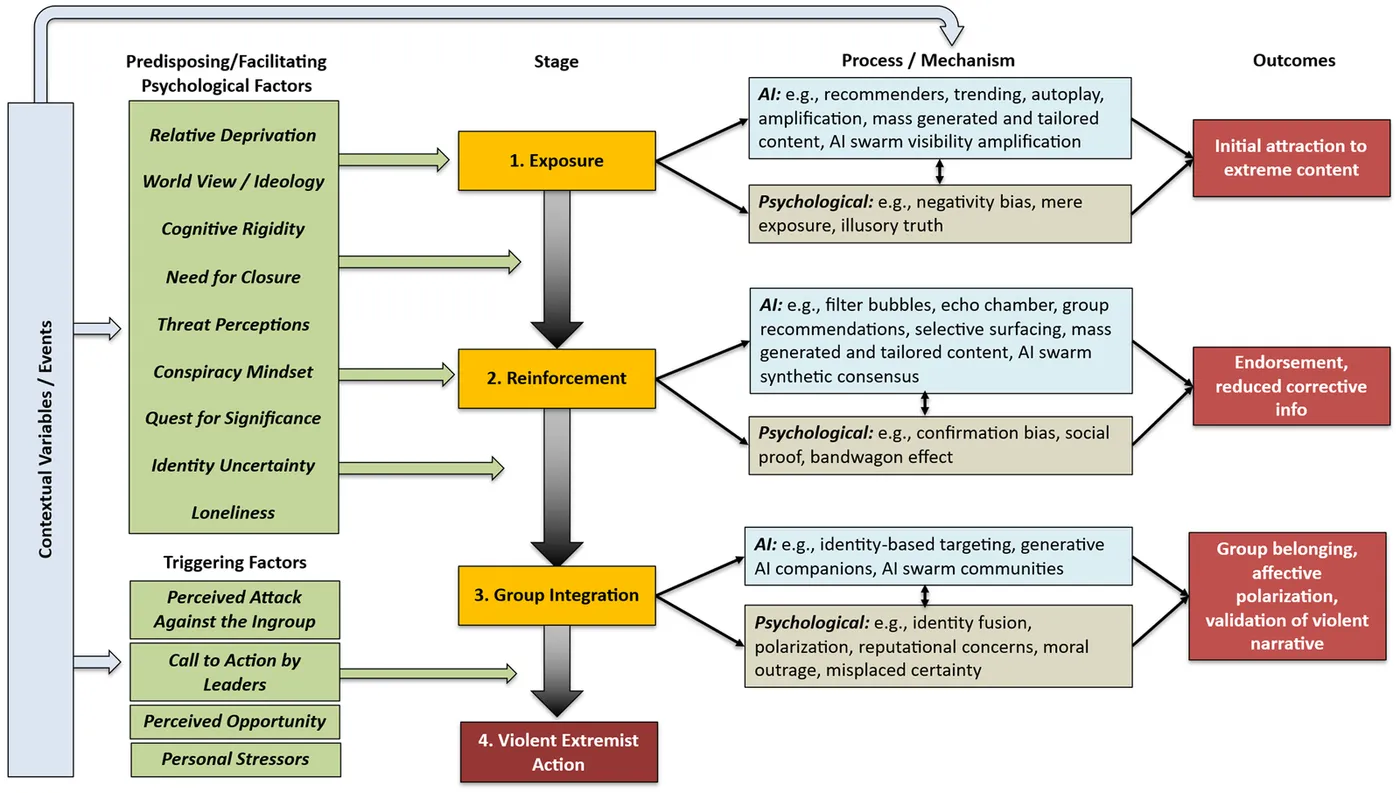
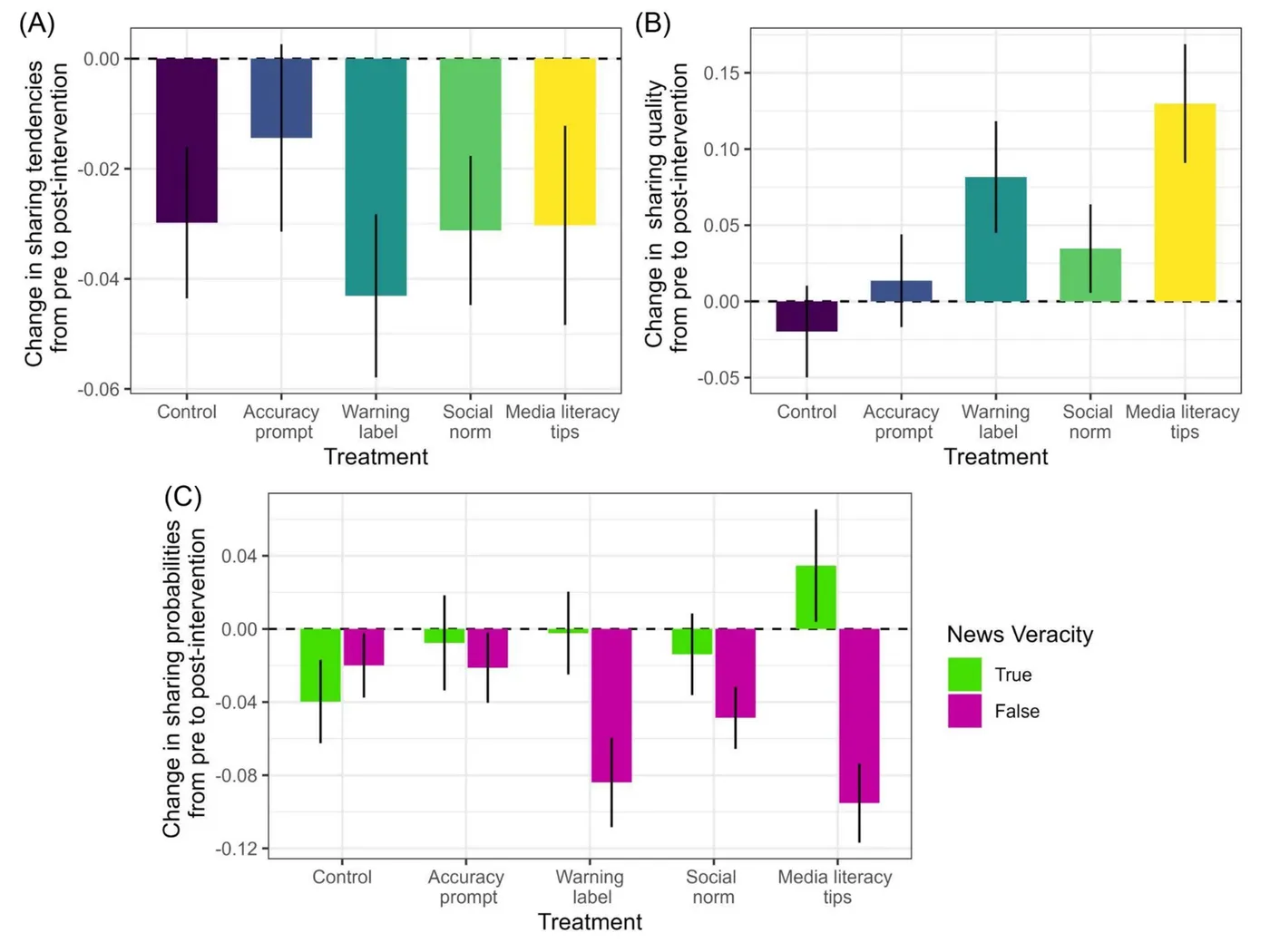
Figure from “Intelligent Systems, Vulnerable Minds: A Framework for Radicalization to Violence in the Age of AI”

Journal of Experimental Psychology: General · 2026

Toward a mechanistic understanding of false news sharing: Which interventions work best, for whom, and why

Gollwitzer, A., Tump, A. N., Martel, C., Deffner, D., Sultan, M., Kurvers, R., & Hertwig, R.

This study examines how to curb false news sharing, drawing on news-sharing decisions from over 1,100 U.S. participants. Comparing leading interventions head-to-head and using drift-diffusion modeling to uncover the decisions behind sharing, it finds that warning labels and media literacy tips substantially improve sharing quality, while social norm cues have a modest effect and accuracy prompts a very subtle one. These benefits hold broadly—even among at-risk groups like conservatives. Critically, each intervention works through a distinct cognitive pathway: warning labels shift people’s initial intentions away from sharing before they engage with content, whereas media literacy tips operate later, improving how news is processed and increasing caution before a decision. The findings clarify which interventions work best, for whom, and in which contexts.

Figure from “Toward a mechanistic understanding of false news sharing: Which interventions work best, for whom, and why”